
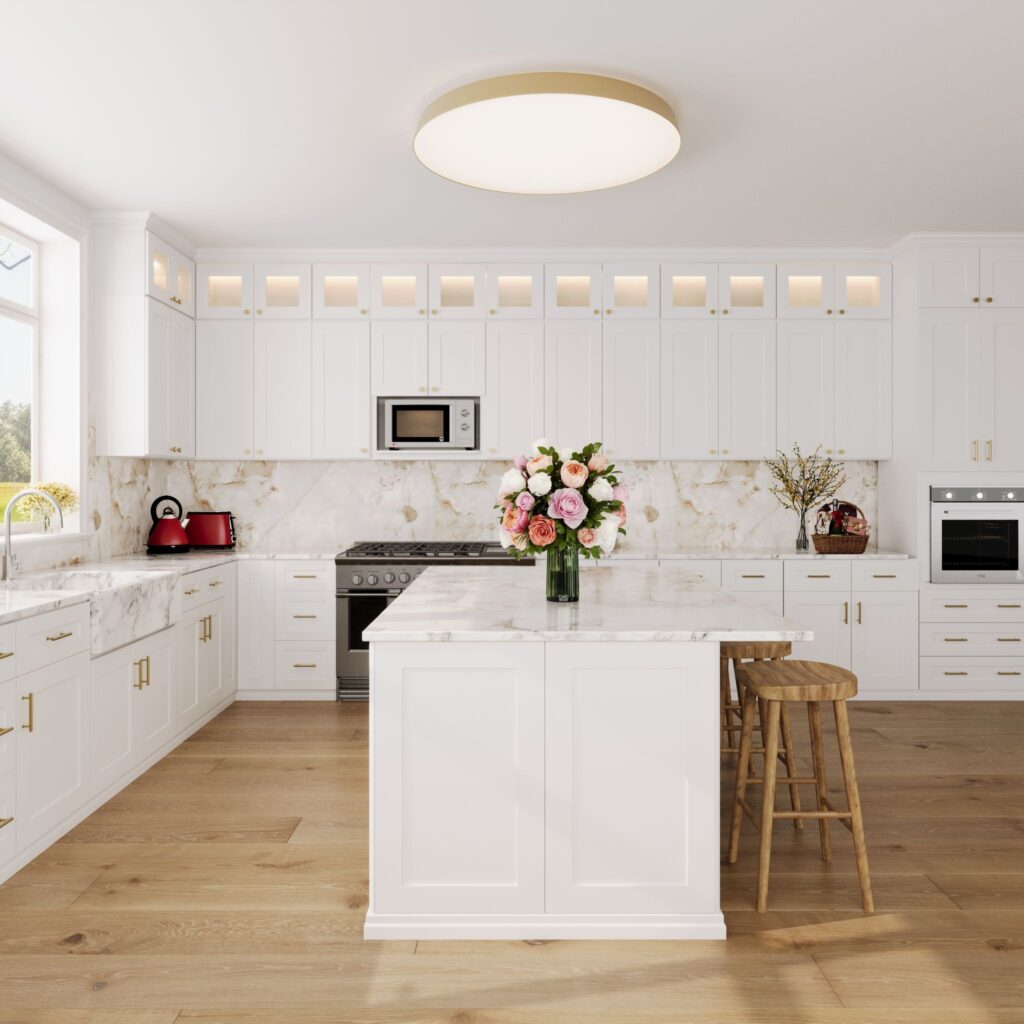
New cabinets are the upgrade that changes a manufactured-home kitchen most for the money. Tear out the thin factory units and put in real cabinets and the room stops looking like it came off a production line. The work itself is well within reach for a handy owner or an afternoon’s labor for an installer.
What trips people up is not the cabinets. It is assuming a manufactured home works exactly like a site-built one. It mostly does, but in three specific places it does not, and each of those three is where an otherwise smooth project goes sideways. The short version: confirm the wall framing before you hang anything, upgrade to a plywood box over the lightweight factory units, and measure the actual space before ordering rather than assuming standard sizing.
How to Anchor Cabinets in a Manufactured Home
In a site-built house you find a stud, drive your screws, and the cabinet hangs. Manufactured homes can be different. Built to federal HUD construction and safety standards rather than local site-built codes, many use thinner wall framing and wider or irregular stud spacing, so the solid wood you are counting on to carry a loaded wall cabinet may not be where, or as substantial as, you assume.
This is the one that causes real trouble, because a wall cabinet full of dishes that pulls out of the wall is not a cosmetic problem. Before hanging anything, find the actual framing with a stud finder and confirm it, do not trust standard spacing. Where the framing is sparse or thin, the fix is simple and worth the hour: open the wall enough to add solid wood blocking between the existing members, screwed in to give your cabinets something real to bite into. Anchor into that, never into drywall alone. Get this right and everything above the counter stays where you put it for decades.
Why Mobile Home Cabinets Wear Out (and What to Replace Them With)
Pull a factory cabinet off the wall and the weight, or lack of it, tells the story. Many original manufactured-home cabinets are thin particleboard or laminate over a lightweight frame, built to a price and a shipping weight rather than to last. That is exactly why they sag, swell, and wear early, and why almost anything you replace them with feels like a serious upgrade.
It also means you should aim higher than what came out. The meaningful step up is a plywood box with a solid-wood face frame. Plywood holds fasteners far better, which matters double given the framing situation in surprise one, and it resists the humidity that builds up in a small, enclosed kitchen far better than the particleboard you are removing. A line of white shaker kitchen cabinets in plywood-box construction clears that bar, and the light finish does a compact kitchen a favor by making it feel larger and brighter than dark cabinets would. Ready-to-assemble units have a bonus here too: they arrive flat, so getting them through a narrow hallway and a tight kitchen doorway is no fight, and they go together on site.
Measuring a Mobile Home Kitchen for New Cabinets
The third snag is dimensions. Manufactured-home kitchens are often more compact, and the original runs sometimes used sizes that are slightly off from the standard widths replacement cabinets come in. Order on the assumption that your kitchen is built to standard and you can end up with a run that does not quite fill the wall, or one cabinet too many to fit.
The protection is unglamorous and total: measure the actual space, twice, before ordering anything. Wall lengths, the gaps for the range and fridge, ceiling height, and where the plumbing comes through. Then order against those real numbers, not against what a kitchen this size “should” be. Standard cabinet lines do fit most manufactured homes well, but only once you have confirmed your kitchen against the tape rather than the assumption. Where a small gap remains, a filler strip closes it cleanly.
Leveling and Budgeting: What Works Like Any Kitchen
Two things, happily, work just like any other kitchen. Leveling is the same discipline, manufactured homes can settle unevenly, so set base cabinets to a level line and shim for the floor rather than following the floor’s dips. And the budget logic is the same, only friendlier: because RTA cabinets run roughly 30 to 50 percent below comparable pre-assembled lines, a compact run can land a real quality upgrade on a budget that would not touch custom. Keep the usual 15 to 20 percent contingency for the old-cabinet removal and whatever you find behind them, and the numbers stay honest.
Frequently asked questions about mobile home cabinets
Can I just use standard cabinets in a mobile home? Yes, standard lines fit most manufactured homes well, as long as you measure the actual space before ordering and anchor into solid framing rather than assuming standard sizing and stud locations.
Why were my original cabinets so flimsy? They were usually built light, thin particleboard or laminate over a lightweight frame, to keep cost and shipping weight down. Replacing them with plywood-box, solid-wood-frame cabinets is a clear step up in durability.
How do I hang cabinets if the walls feel thin? Find the real framing with a stud finder and anchor into it, not into drywall. Where framing is sparse, add solid wood blocking inside the wall first to give the cabinets a dependable anchor.
Are flat-pack cabinets a good fit for a mobile home? Particularly good. They ship flat, so moving them through narrow doorways into a tight kitchen is easy, they assemble on site, and plywood-box versions far outlast typical factory units.
Will new cabinets blow my budget? Less likely than you fear. RTA’s savings over pre-assembled lines, roughly 30 to 50 percent, puts a quality upgrade within reach of a modest budget, especially for the smaller cabinet runs common in manufactured homes.
Handle the three surprises, walls, weight, and dimensions, and a manufactured-home cabinet swap turns into the high-impact, sensibly-priced upgrade it should be. The cabinets were never the hard part. The assumptions were.
More Stories
Planning a DIY Radiant Barrier Installation in Your Attic
How to keep your bathroom surfaces free from stubborn limescale
When Is a Temporary Roof Repair Useful, and When Is It Only Buying Time?