

Waking up with a sore back again? Your mattress might be sabotaging your sleep and your mornings.
I used to think my chronic shoulder pain was just a standard part of getting older. As it turns out, it was my decade-old spring mattress creating pressure points all night long. Three months after switching to a quality memory foam mattress, that morning stiffness finally disappeared.
If you are curious about whether memory foam is right for you, let’s break down the actual science without the heavy jargon and see what it means for your sleep quality.
What is memory foam, anyway?
Memory foam actually started as a NASA technology back in the 1960s. It was developed to cushion astronauts during takeoff. The material is designed to respond to your body heat and pressure, moulding to your unique shape before slowly bouncing back once you get up.
That “memory” of your body creates a level of personalised support that traditional spring mattresses simply cannot match. If you are looking to upgrade your setup, exploring a range of memory foam mattresses is the first step toward finding that tailored support.
How memory foam actually improves your sleep
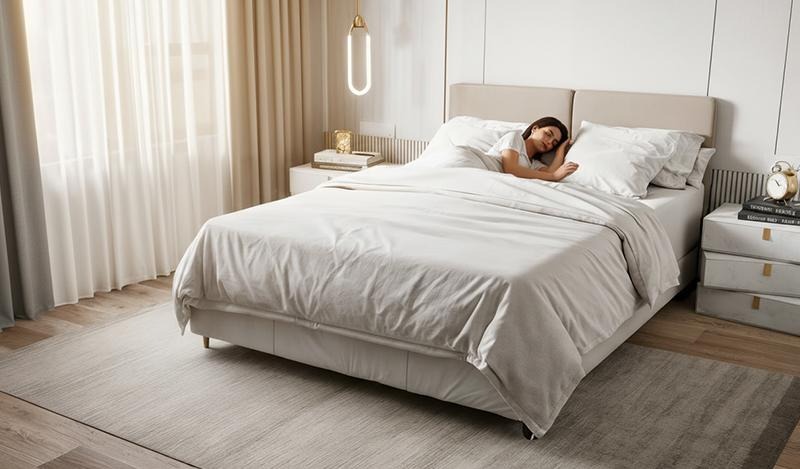
It eliminates those painful pressure points
The reality of traditional spring mattresses is that they push back with equal force everywhere. Your shoulders and hips, which carry most of your body weight, end up bearing far too much pressure.
Memory foam works differently because it redistributes your weight across the entire sleep surface instead of concentrating it in a few spots. Pressure mapping studies show memory foam can reduce peak pressure points significantly compared to spring mattresses, often by 60-95% depending on density and design. This means less tossing and turning while you try to find a comfortable position.
It keeps your spine aligned while you sleep
Your spine has natural curves and maintaining those curves for seven or eight hours straight is the real challenge.
Mattresses that are too firm force your spine into awkward positions, while mattresses that are too soft let heavy areas, such as your hips, sink too much. This throws everything out of alignment. Memory foam gives where you need cushioning and provides support where you need it most. The result is that your spine stays in its natural position whether you sleep on your back, side, or stomach.
Research indicates memory foam helps maintain spinal alignment better than many innerspring options by contouring to body curves.
It stops your partner’s movement from waking you
If you share a bed, this might be the most immediately noticeable benefit. Traditional innerspring mattresses transfer motion across the entire bed. If your partner rolls over, you feel it. If they get up at 6 am, you are awake too.
Memory foam absorbs movement instead of transferring it. The material’s cellular structure acts like a buffer, compressing locally rather than creating waves across the bed. Independent tests confirm quality memory foam reduces motion transfer by 80-94% compared to innerspring mattresses..
Modern versions do not “sleep hot” anymore

Early memory foam had one big problem: it trapped heat like crazy. However, modern memory foam has evolved dramatically. Here is what has changed:
- Gel infusions: Gel particles absorb and dissipate heat more effectively.
- Open-cell structure: This allows air to flow through the mattress instead of getting trapped.
- Phase-change materials: These actually help regulate your temperature throughout the night.
- Copper or graphite: These materials conduct heat away from your body.
For our Australian summers, look for “cooling gel” or “gel-infused” labels. The difference is quite noticeable when the mercury rises.
What to look for when shopping

Not all memory foam is created equal. To help you navigate the showroom or the website, here is a quick breakdown of what actually matters for your comfort and longevity.
| Feature | What it does | Recommended Spec |
| Density | Determines how long the foam lasts before sagging. | Aim for at least 80 kg/m³. |
| Cooling Tech | Prevents heat buildup during hot Aussie nights. | Look for Gel-infused or Open-cell foam. |
| Certification | Ensures no harmful chemicals are used in production. | Look for CertiPUR-US® or OEKO-TEX®. |
| Layers | Balances the “sink” with proper structural support. | A minimum of 3 distinct layers. |
| Trial Period | Gives your body time to adjust to the new feel. | At least a 90-day “no questions” trial. |
The honest downsides
Memory foam is not perfect for everyone, and it is worth being realistic about the drawbacks:
- Adjustment period: It usually takes about a month to get used to the unique feel. Your body has adapted to your old mattress, so switching requires some recalibration.
- Naturally hot sleepers: Even with cooling technology, some people still find foam warmer than springs. If you sleep extremely hot, you might prefer a “hybrid” mattress which combines foam with springs.
- Stomach sleepers: The conforming nature might allow too much sinking for some. Firmer memory foam can work, but innerspringsinnerspring often suit this position better.
- Weight limits: Very heavy individuals, typically those over 120kg, may need high-density foam or hybrid construction to avoid “bottoming out” the support layer.
The bottom line
Memory foam is not just marketing hype; it is material science solving real sleep problems. The research is clear: you get measurable pressure relief, improved spinal alignment, and fewer sleep disturbances. Clinical studies show significant improvements in both pain levels and overall sleep quality.
If you are waking up tired despite getting enough hours in bed, your mattress is likely the culprit. Your one-third of life spent sleeping deserves to have material science working in your favour.
More Stories
Planning a DIY Radiant Barrier Installation in Your Attic
How to keep your bathroom surfaces free from stubborn limescale
When Is a Temporary Roof Repair Useful, and When Is It Only Buying Time?