
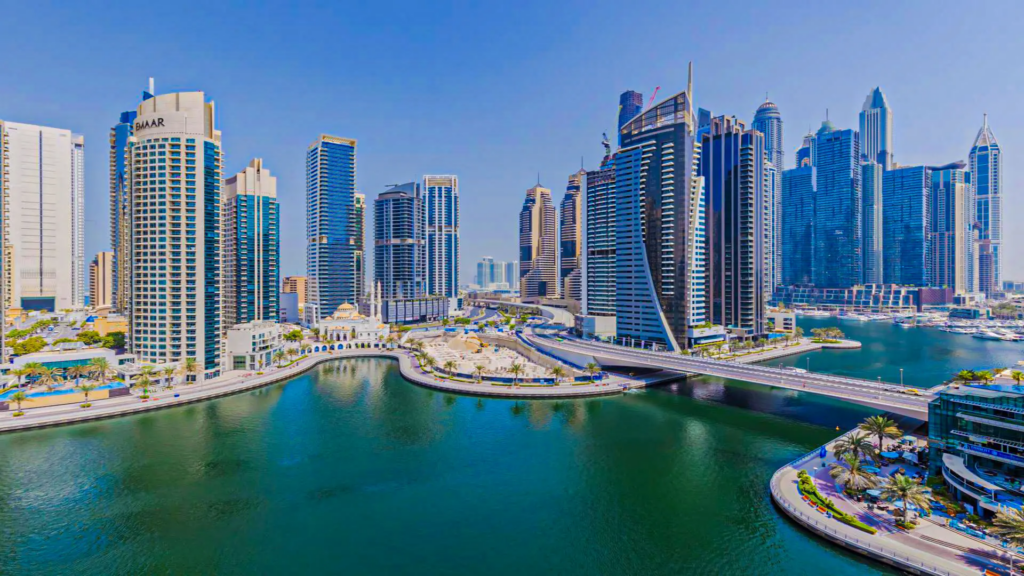
Ask someone why they bought in Dubai Marina and the first answer is rarely about yield calculations or square footage. It is almost always about what they saw when they stood at the window. The water below, the boats moving through the channel, the skyline bending around a marina that was carved out of the desert floor in under two decades. That answer tells you something important about how this district functions in the minds of buyers, and why the usual frameworks for evaluating real estate only partially explain what drives decisions here.
Dubai Marina is not a neighbourhood that sells on fundamentals alone. It sells on something harder to model, an experience of place that very few urban addresses anywhere in the world can credibly offer at its price point. Understanding how that experience shapes buying behaviour, and why it has sustained demand through market cycles that have tested nearly every other district in Dubai, is what this article is about.
What Was Actually Built Here
Before talking about buyer psychology, it helps to understand the physical reality of what Dubai Marina is, because the engineering achievement is itself part of the story buyers respond to.
The Marina is built along a three-kilometre stretch of the Arabian Gulf shoreline. A channel was excavated from the sea, creating an inland waterway that functions as a working marina while forming the centrepiece of an entire residential district. The development spans 50 million square feet and is enclosed by over 200 residential towers. The seven-kilometre Marina Walk promenade runs the perimeter of the water, past more than 60 waterfront restaurants, cafes, and retail outlets, lined with superyachts that residents pass on their morning runs.
The Dubai Marina Yacht Club operates over 500 berths. Princess Tower, at 414 metres, held the title of the world’s tallest purely residential building for three years after its completion in 2012. The Cayan Tower, which achieves a full 90-degree rotation from base to crown by rotating each of its 73 identical floor plates 1.2 degrees around a central core, became one of the most photographed buildings on earth. These are not decorative facts. They establish that Dubai Marina was designed to be a landmark destination, not just a residential community, and that distinction matters enormously to the buyers it attracts.
When someone purchases here, they are not simply buying a unit in a building. They are buying an address that exists in the global imagination. That brand recognition has tangible financial consequences for liquidity, rental demand, and resale value that persist even when other parts of the market soften.
The Waterfront Premium and What Buyers Are Actually Paying For
The price difference between a Marina-facing unit and an inland-facing unit in the same tower can reach AED 400 to AED 600 per square foot. Buyers who have studied the district know this before they arrive. What they are working through during a viewing is whether the premium is justified by what they see, feel, and can practically do with the property.
For most buyers, the justification resolves around three things that waterfront positioning delivers and no amount of inland amenity can replicate.
The first is irreplaceable views. The Marina channel does not have undeveloped land adjacent to it. The towers are built. The promenade is established. A buyer who secures a unit facing the water today can be confident that the view they are paying for will still be there in fifteen years. That certainty is not available in newer communities where construction cranes are a permanent fixture on the horizon and the building across the street that currently does not exist may be thirty floors tall within three years.
The second is walkability. Dubai Marina delivers something genuinely rare in a city built around cars: a daily life that does not require one. Residents walk to the supermarket, to restaurants, to the gym, to the tram stop, to the beach at JBR five minutes away on foot. The DMCC Metro station connects the district to Sheikh Zayed Road and the broader network. The Dubai Tram loops through the community. For young professionals, couples, and international buyers who have lived in walkable cities before, this is not a luxury. It is a baseline requirement, and Dubai Marina is one of the only addresses in the city that meets it fully.
The third is immediate access to a functioning social and recreational environment. The Marina Walk operates effectively as a public amenity for residents. It is free to access, open around the clock, and generates exactly the kind of daily street life that makes a neighbourhood feel alive rather than dormant. Buyers who have previewed communities where the retail is still being built and the restaurants have not yet opened understand the difference. Marina Walk has been operating for over a decade. The restaurants are not placeholders. The community is not aspirational. It exists.
Who Is Buying and Why the Profile Matters
According to Bayut’s full-year 2025 sales market report, Dubai Marina retained its position as the most preferred destination for luxury apartment purchases across the entire city, with Downtown Dubai and Dubai Creek Harbour following. Apartment sales and purchase was most active in Dubai Marina across the year according to Betterhomes data. This is not a market that is discovering Marina. It is a market that keeps returning to it, which is a fundamentally different signal.
The buyer profile in Dubai Marina is worth examining closely because it explains the consistency of demand. The three dominant buyer groups are high-earning expatriate professionals, international investors purchasing remotely, and end-users making long-term lifestyle commitments to the city.
Expatriate professionals working in Dubai Internet City, Dubai Media City, and TECOM, all of which are within ten to fifteen minutes on foot or tram from the Marina, gravitate to the district because the commute and the evening social scene resolve simultaneously in a single address. They are not optimising for yield. They are optimising for the quality of life that a demanding career in a city with no natural civic tradition of street life can still deliver if you choose the right neighbourhood.
International investors, particularly those from European and South Asian markets, consistently rank Dubai Marina in their first three target areas because the brand requires no explanation. When a landlord in Amsterdam or Mumbai discusses their Dubai property with a prospective tenant, saying “Dubai Marina” closes the conversation in a way that saying “Arjan” or “Dubai South” does not. That recognition is real economic value. It sustains rental demand and supports resale liquidity in ways that are difficult to quantify on a spreadsheet but deeply understood by experienced property holders.
End-users who have passed the consideration phase and committed to Dubai as a long-term or permanent base typically arrive at Marina after having rented in other districts. They have usually experienced the difference between a community with mature infrastructure and one that is still developing it. They buy here because they know what they are getting.
The Rental Case for Waterfront
Rents across Dubai Marina increased approximately 8 to 10 percent year on year through 2025, supported by constrained supply and consistent demand from professional tenants. Studio rents in the Marina average around AED 7,500 per month, approximately 50 percent above the Dubai citywide studio average, which is a direct reflection of the premium that waterfront connectivity and lifestyle density commands over standard apartments elsewhere in the city.
Gross rental yields for standard long-let apartments sit between 5.5 and 7.2 percent, with smaller units performing at the higher end of that range. For investors pursuing the short-term rental market with a DTCM holiday home permit, well-managed one-bedroom units in premium Marina towers achieve occupancy rates of 75 to 85 percent across the year, with average daily rates running between AED 350 and AED 550 depending on season and building quality. The gross yield from a well-run holiday home in the Marina can reach 8.5 to 12 percent, though this requires active management and a meaningful time investment that passive investors should factor into their return calculations.
The structural reason rental demand holds up in Dubai Marina is that the tenant base is not particularly price-sensitive relative to the premium being charged. The professional class that rents here consistently places lifestyle and location above marginal cost savings. A tenant who can afford a one-bedroom in the Marina is not seriously considering a one-bedroom in an outer community forty-five minutes from their office. They are comparing towers within the Marina itself. That comparative dynamic keeps competition between landlords contained and vacancy rates low.
Rental demand in the Marina also benefits from a supply constraint that emerges from the district’s own success. The community is effectively built out. There are no large undeveloped plots where new residential towers can be added at scale. The apartments that exist today represent the overwhelming majority of the apartments that will ever exist in the Marina at this density and this address. That physical limitation is not a weakness for investors. It is a moat.
The Short-Term Rental Dynamic and What It Does to the Buyer Decision
Dubai Marina is one of Dubai’s top five most-searched neighbourhoods on international platforms for short-term rentals. The city attracts over 17 million visitors annually, and waterfront communities anchor a significant share of the high-end tourist accommodation market. This is relevant to buyer decisions in a specific way.
Many buyers in the Marina purchase with a dual mandate: they want a property they can use personally when in Dubai, while generating income during periods when they are not in residence. The Marina is one of the very few districts in Dubai where this dual-use model works cleanly at scale. The waterfront setting and the lifestyle infrastructure are exactly what short-term visitors seek, the licensing framework through DTCM is well-established, and the management ecosystem is mature enough that investors can hand a property to an operator and receive structured returns without needing to manage it day to day.
This is a different kind of buyer motivation than pure yield-seeking or pure end-use planning, and it is one that Dubai Marina services better than almost any other district in the city. When someone is evaluating buying apartments in Dubai Marina, this flexibility of use is often a decisive factor that tilts the decision from consideration to commitment. The property functions as a personal asset and an income-generating investment simultaneously, which justifies the premium relative to community-only options that would require a more binary choice.
Why Supply Constraints Sustain the Premium
There are approximately 366,000 residential units projected to enter the Dubai market by 2028. The overwhelming majority of that supply is concentrated in outer districts: Dubai South, Dubailand, areas around the Expo City corridor, and emerging communities that are building from the ground up. Dubai Marina is not receiving a meaningful portion of that supply. The towers are built. The channel is established. New projects launching in the Marina are rare, and when they do come to market, they sell quickly and at prices that reinforce rather than undercut the existing stock.
This matters to buyer decisions because one of the legitimate concerns in any high-supply market is whether the asset being purchased will face price pressure from new inventory. In the Marina, that concern is substantially reduced. Investors who have watched emerging communities absorb successive waves of new supply and watched yields compress accordingly are deliberately paying the Marina premium to avoid that dynamic.
The flipside is that buyers entering the Marina for the first time should understand that they are typically purchasing in a mature, secondary market. The appreciation trajectory that characterised the district from 2003 to 2015 is not the expectation today. What buyers are purchasing instead is stability, liquidity, and a defensible position in a district that the market has validated repeatedly across multiple cycles. For many buyers, particularly those with a medium to long-term holding horizon, that trade is precisely what they want to make.
The Experience That Data Cannot Fully Capture
There is a final dimension to waterfront buying decisions in Dubai Marina that market reports touch on but cannot fully quantify. It is the way the district feels on a Tuesday evening in November when the temperature drops to twenty-three degrees and the promenade fills with people who live there, and the boats are lit against the dark water, and the restaurants are at capacity, and the skyline closes around the scene in a configuration of towers unlike anything that existed on this coastline twenty years ago.
Buyers who have spent time in the Marina before purchasing consistently describe a version of that experience in the decision-making narrative. It does not replace spreadsheets. It does not substitute for yield analysis or service charge due diligence or a proper legal review of the title. But it is real, and it operates on a part of the buyer’s assessment that purely rational analysis does not reach.
The waterfront premium in Dubai Marina is, at its core, the market’s way of pricing that experience. The fact that it has held up across more than two decades of development, across cycles of oversupply and correction in other districts, across global uncertainty and local market shifts, suggests that the buyers pricing it in are not making an error. They are making a judgment that a certain kind of place commands a certain kind of value, and that the supply of such places in Dubai is genuinely limited.
That judgment has been right more often than it has been wrong. And in real estate, that is about as durable a foundation as you will find.
More Stories
When Could Sustainable Packaging Change Consumer Preferences For Mylar Magic?
Modern Recliner Sofas for Comfortable and Practical Living Rooms
How to Read a Kratom Lab Report Against the Proposed 7-OH LimitsGloved hands using a micropipette to spot a sample onto a thin-layer chromatography plate in a lab