
When you’re shopping for a toaster oven air fryer, there’s one feature that’s hard to miss: the words “Air Fry.” Almost every brand seems to put them somewhere on the product page. And honestly, it’s easy to think that if an oven has an Air Fry function, then it should automatically be able to make crispy fries, chicken wings, and other air-fried foods.
But that’s not always how it works. I’ve seen plenty of toaster ovens that technically have an air-fry setting, but the results can be very different from one appliance to another.
So, what makes the difference?
In my opinion, one of the most important things to look at isn’t the number of cooking functions. It’s airflow.
What Actually Happens When You Air Fry?
Air frying sounds simple: hot air cooks the food and makes it crispy. But there’s a little more going on. When food is cooking, moisture needs to move away from the surface. At the same time, hot air needs to circulate around the food so that the outside can dry and brown properly.
That’s why air frying isn’t just about how hot an appliance can get. It’s also about how well it can move that hot air around your food.
Think about french fries. If you put too many fries into a small basket and they are all piled on top of each other, the hot air can’t reach the fries stuck in the middle of the basket. The result? Some fries become crispy while others stay soft.
The same thing can happen inside a toaster oven air fryer. The cooking chamber may be larger, but if the airflow isn’t strong or well distributed, simply having more space doesn’t automatically give you better results.
Why the Fan Matters
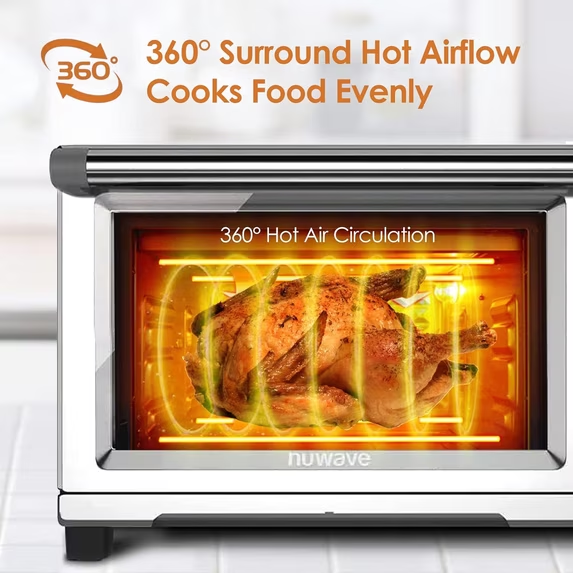
This is where the fan comes into the picture. A fan helps move hot air around the cooking chamber. But not every fan system is designed the same way. The fan speed, airflow direction, heating elements, and overall cooking chamber design can all affect how efficiently heat reaches the food.
Some toaster ovens use convection mainly to help distribute heat evenly during baking. An air fryer, on the other hand, needs to move hot air quickly enough around the food to help create that characteristic crispy exterior.
That’s why I wouldn’t choose a toaster oven air fryer simply because the product page says:
“Air Fry Function.”
I’d want to know a little more.
How powerful is the fan?
Does the appliance have different fan speeds?
Where does the air move?
Does the air-fry basket allow air to circulate underneath the food?
These details may not sound exciting when you’re shopping, but they can make a noticeable difference when you’re actually cooking.
Bigger Doesn’t Always Mean Better

There’s another common assumption I think is worth talking about. People often assume that a larger toaster oven air fryer must automatically be better because it can cook more food.
And yes, capacity is important. If you’re cooking for a family, having enough room for a larger baking dish, pizza, or a bigger batch of chicken wings can be incredibly convenient.
But a bigger cooking space also creates another challenge.
There’s more distance needed for the hot air to travel to reach your food.
If an appliance has a large cooking chamber but doesn’t have a good airflow system, the food may not cook as evenly as you’d expect. That’s why I like to think about capacity and airflow together.
You want enough room to cook the amount of food you need, but you also want an airflow system that can actually make good use of that space. This is especially important when you’re air frying.
The Air-Fry Basket Is More Important Than You Might Think
Let’s talk about something that doesn’t always get enough attention: the basket.
When you’re air frying, you don’t want your food sitting on a completely solid surface if you can avoid it. A mesh or perforated basket allows hot air to reach more of the food’s surface, including underneath. That can help the food cook and crisp more evenly.
For example, if you’re making chicken wings, placing them in a single layer with some space between each piece gives the hot air more room to circulate. If you pile everything together, even a powerful fan can only do so much. This is one reason I always recommend not overcrowding your food. It’s a small thing, but it can make a surprisingly big difference.
So, Does a Toaster Oven Air Fryer Really Need Strong Airflow?
In my opinion? Yes, airflow is extremely important, especially if air frying is one of the main reasons you’re buying the appliance. You can have a toaster oven with ten, twelve, or even more cooking functions. But if you mainly bought it because you want crispy chicken wings and French fries, those extra buttons don’t mean much if the air-frying performance isn’t good.
That’s why I would put airflow pretty high on my checklist. You should still consider temperature control, capacity, heating elements, accessories, cleaning, and safety. But don’t overlook the way the appliance actually moves air.
What About Other Cooking Methods?
Here’s the interesting part. Good airflow isn’t only useful for air frying. A well-designed countertop oven can use different combinations of heat and airflow depending on the cooking method.
For example, baking doesn’t always require the same kind of aggressive airflow as air frying. When you’re making a cake or cookies, you may care more about stable temperature and even heat distribution. When you’re roasting chicken, you might want good circulation around the food while still maintaining enough heat to cook the center. And when you’re broiling, direct heat from the upper heating elements becomes much more important.
This is why I like multifunctional countertop ovens. You’re not relying on one cooking method for everything. You can choose the method that makes sense for the food you’re making.
What I Look for When Buying a Toaster Oven Air Fryer
If I were shopping for a toaster oven air fryer today, I wouldn’t just compare the number of presets. I’d look at a few practical things.
1. Airflow Design
Look for information about the fan and how air moves through the cooking chamber. If a manufacturer provides details about fan speeds or airflow technology, that’s worth paying attention to.
2. Air-Fry Basket
A good air-fry basket should allow air to move around the food rather than keeping it pressed against a solid surface.
3. Cooking Capacity
Think about what you actually cook. If you’re only making toast and reheating leftovers, you probably don’t need a huge countertop oven. But if you regularly cook for a family, bake larger dishes, or prepare multiple servings, extra capacity can make everyday cooking much easier.
4. Temperature Control
Different foods need different temperatures. I’d rather have an appliance with reliable temperature control than one with a long list of presets that I rarely use.
5. Other Cooking Functions
Air frying is great, but it’s not the only thing you’ll cook. If the appliance can also bake, broil, roast, toast, reheat, or dehydrate, think about whether those functions could actually replace some of the appliances you already have.
A Real-World Example
The Nuwave Bravo XL Pro is one example of a smart countertop air fryer toast oven combo that takes airflow into consideration.
It has a high-speed fan with three fan-speed settings, and the highest fan speed is designed for functions such as air frying, broiling, and searing. It also has a 30-quart cooking capacity, which gives you more room than a typical small basket-style air fryer.
For someone who wants to use one countertop appliance for more than just air frying, that’s an interesting combination. But I think the bigger takeaway is this:
Don’t buy a toaster oven air fryer just because it has an Air Fry button.
Look at what’s behind that button.
A Few Simple Tips for Better Air-Fried Food
Even if you already own a toaster oven air fryer, you can often improve your results without buying a new appliance.
Here are a few things worth trying:
Don’t overcrowd the basket.
Give the hot air enough room to move around the food.
Use a single layer when possible.
This is especially helpful for fries, vegetables, and chicken wings.
Leave some space between pieces.
Food packed tightly together can block airflow.
Turn or shake the food when needed.
Depending on the recipe, turning food halfway through cooking can help it brown more evenly.
Use the right accessory.
A proper air-fry basket can make a difference compared with a solid baking tray.
These aren’t complicated tricks. But sometimes, the simplest changes have the biggest impact.
The Bottom Line
When you’re comparing toaster ovens with air-fry functions, it’s easy to get distracted by the number of cooking modes.
12-in-1 sounds better than 8-in-1. A bigger temperature range sounds better. More presets sound better. But when it comes to air frying, I think there’s a more important question:
How well does the appliance move hot air around the food?
That’s what I’d pay attention to.
A good toaster oven air fryer should give you enough cooking space for your needs, provide effective airflow, and give you enough control to adjust the cooking method depending on what you’re making. And if you can find all of that in one countertop appliance, even better.
At the end of the day, the best cooking appliance isn’t necessarily the one with the longest feature list. It’s the one that makes the food you actually cook easier, better, and more enjoyable to prepare. Because that’s really what we’re looking for when we bring another appliance into our kitchen.
Not more buttons. Just better cooking.
More Stories
10 Best Tree Service Companies In Nashville, Tennessee
Managing Roof Runoff Without Damaging Your Landscape
The rising cost of construction litigation and how to avoid it